

The science behind SKEION
How a solar eruption builds up.
Thirty years of research have shown how the Sun’s magnetic field stores the energy of an eruption, and what can hold it back. The work was led by Tahar Amari at CPHT (CNRS / École polytechnique) and published in Nature. SKEION is developing its own forecasting engine from this published science.
New to space weather? Follow a storm from the Sun to the Earth

Published results
Two results on the cover of Nature.
-
2014
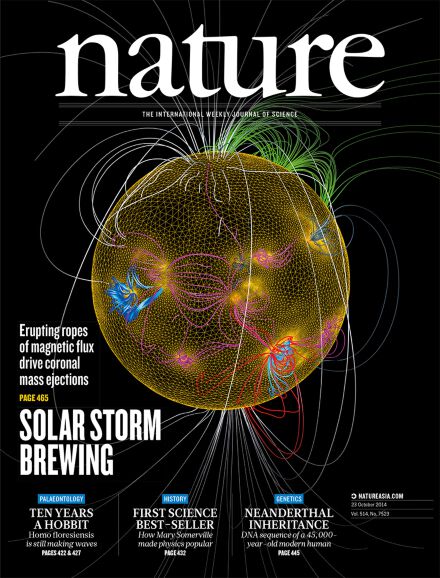
The flux rope behind a major eruption
The team started from four days of measurements of the Sun’s magnetic field, before a major eruption (December 2006). Its simulation rebuilt the twisted structure (a flux rope) behind it.
Class X3.4 flare · Amari, Canou & Aly, Nature 514, 465 (2014) · doi:10.1038/nature13815
-
2018
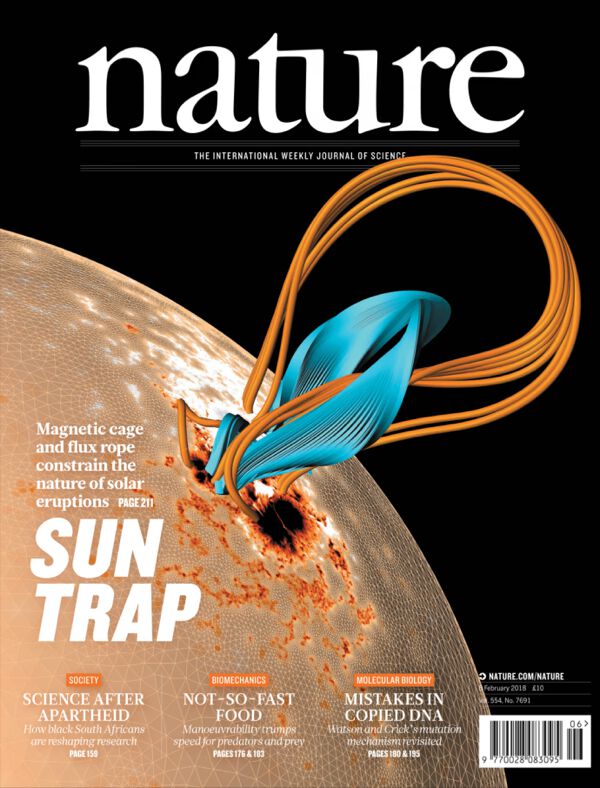
Why an eruption stays confined
The team showed why a major eruption in October 2014 ejected nothing: a “magnetic cage” held the twisted structure in.
Amari, Canou, Aly, Delyon & Alauzet, Nature 554, 211 (2018) · doi:10.1038/nature24671


Our ambition: to tell, before an eruption starts, whether it will eject matter or stay confined. This bears directly on false alarms. Our goal is not to promise, but to prove.
The approach
How physics describes the Sun.
The equations of the solar plasma
The Sun’s outer atmosphere, the corona, is a plasma: a hot, electrically charged gas threaded by magnetic fields. Plasma and field drag each other along. A physical model solves the equations of this coupling in 3D, called magnetohydrodynamics (MHD). They describe how mass, momentum, energy and the magnetic field evolve.
Fine detail where the physics needs it
Such a model divides space into cells, an adaptive mesh. Cells are small where magnetic structures are thin, such as a flux rope, and larger elsewhere.
What SKEION builds on it
SKEION is developing its own forecasting engine from this published science. Its goal: to tell satellite operators, one to two days ahead, what a solar storm will do to each of their satellites.
Our workshop
aiXplore, the Sun’s magnetic field in 3D.

aiXplore displays the Sun’s magnetic field in 3D. It reads the results of magnetohydrodynamics simulations, the physics of the hot, magnetised gases that make up the Sun, and automatically spots precursor signs of eruptions in them. It is the workshop where SKEION prepares its forecast.

The researcher
Tahar Amari led this research at the CNRS.

Tahar Amari is a Director of Research at the CNRS and a solar physicist, at the Centre de physique théorique (CPHT, CNRS / École polytechnique). He has worked on solar physics for 30 years. His published work is the science SKEION builds on.
His other papers: the heating of the solar atmosphere (Nature, 2015) and twisted flux ropes in the quiet Sun (2025).
Glossary
Key terms.
- Magnetohydrodynamics (MHD)
- The physics of electrically conducting fluids, such as the solar plasma, and of the magnetic fields they carry along.
- Magnetic flux rope
- A bundle of magnetic field lines wound around one another, which stores the energy of an eruption.
- Magnetic cage
- The magnetic arches that lie over a flux rope and hold it down. Its strength decides whether an eruption ejects matter or stays confined (Amari et al., 2018).
- Coronal mass ejection (CME)
- A cloud of plasma and magnetic field expelled from the solar corona, at about 250 to nearly 3,000 km/s.
Further reading: NOAA on coronal mass ejections · NASA on the magnetic cage (2018).
Questions
Common questions.
What does this research make possible?
It rebuilds the magnetic configuration of the solar corona before and during eruptions, starting from observations of the Sun’s magnetic field. SKEION’s goal is to turn this physics into a forecast: to tell operators, one to two days ahead, what a storm will do to each of their satellites.
Physical or statistical model: what is the difference?
A statistical model learns correlations from past events. A physical model computes how the plasma and the magnetic field evolve, from the laws of physics. Its results read as structures, such as a flux rope and its cage.
Where does SKEION come from?
From thirty years of research in solar physics, led at CNRS by Tahar Amari and published notably on the cover of Nature. SKEION develops its own software from this published science.
Where can I read the papers?
Through their DOI: each reference links to the article. The 2014 and 2018 articles made the cover of Nature (issues of 23 October 2014 and 8 February 2018).
References
The papers.
- Amari, T., Canou, A. & Aly, J.-J. (2014). Characterizing and predicting the magnetic environment leading to solar eruptions. Nature 514, 465–469. doi:10.1038/nature13815 · cover
- Amari, T., Luciani, J.-F. & Aly, J.-J. (2015). Small-scale dynamo magnetism as the driver for heating the solar atmosphere. Nature 522, 188–191. doi:10.1038/nature14478
- Amari, T., Canou, A., Aly, J.-J., Delyon, F. & Alauzet, F. (2018). Magnetic cage and rope as the key for solar eruptions. Nature 554, 211–215. doi:10.1038/nature24671 · cover
- Amari, T., Canou, A., Velli, M. et al. (2025). The Ubiquity of Twisted Flux Ropes in the Quiet Sun. The Astrophysical Journal Letters 984, L37. doi:10.3847/2041-8213/adb74f
A pilot project with SKEION?
In a pilot project, we explore with you how our solutions can meet your specific needs and solve your problems. From your case, we adapt and improve them so they fit the way your teams work.